

How AI Voice Agents Work | Complete Guide for Businesses
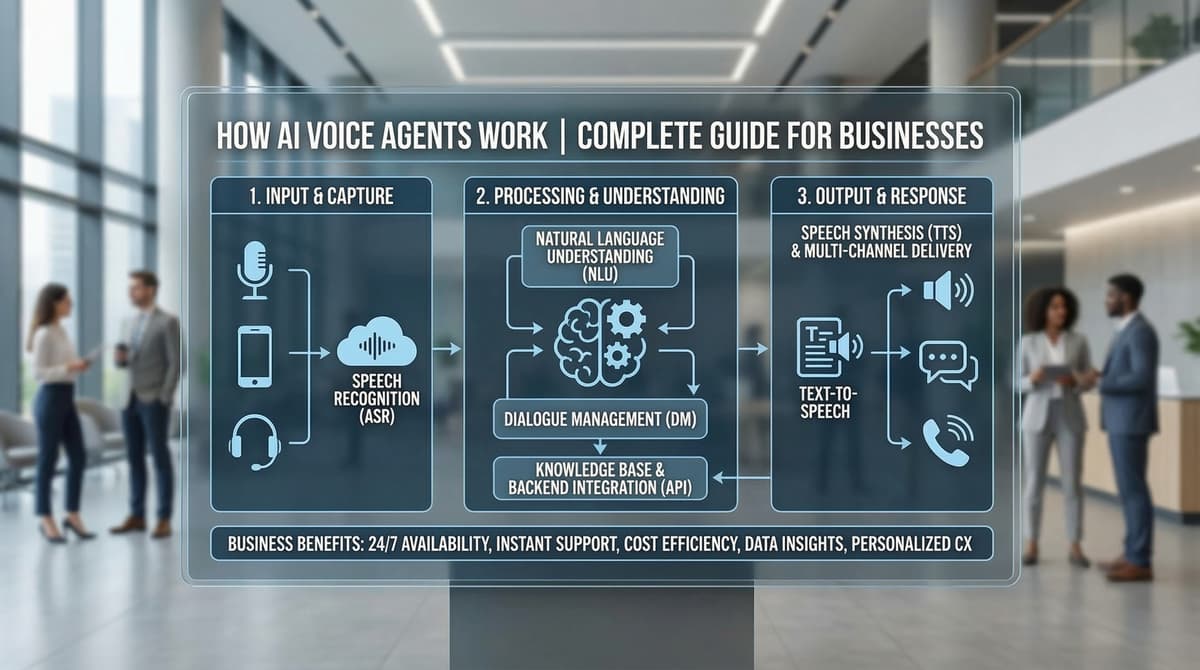
AI voice agents are becoming essential for modern businesses, especially those managing high call volumes and requiring quick, accurate, and 24/7 communication. Whether handling customer queries, booking appointments, verifying orders, or doing follow-ups, AI voice agents are reshaping how companies operate.
But how do these AI voice agents actually work?
What technologies allow them to listen, understand, think, and respond like a human?
This guide breaks the process down step by step — in simple, human language.
Complete Guide: How AI Voice Agents Work
1. What Is an AI Voice Agent?
An AI voice agent is a digital voice assistant that can hear, understand, and respond to people in real-time.
It performs many tasks traditionally handled by call centre agents:
- Answer calls
- Make outbound calls
- Understand customer questions
- Provide answers
- Take actions such as booking, updating, or verifying information
Unlike humans, AI agents work 24/7, scale instantly, and respond consistently every time.
How AI Voice Agents Work (Step-by-Step)
AI voice agents combine multiple advanced technologies to deliver human-like conversations. Let's break the system into five key stages.
2. Step 1: Automatic Speech Recognition (ASR)
The first step is listening.
When a customer speaks, the AI converts voice into text using ASR technology.
ASR identifies:
- Words
- Speech patterns
- Accents
- Tone
- Background noise
Modern ASR systems are highly accurate, making them suitable for multicultural environments like Dubai, India, and the US, where people speak with different accents.
3. Step 2: Natural Language Understanding (NLU)
Once the AI has converted speech into text, it must understand what the user means.
NLU helps identify:
- Intent → What the customer wants
- Entities → Dates, names, order numbers, locations
- Sentiment → Tone of voice (confused, frustrated, etc.)
Example:
"I want to change my booking for tomorrow."
The AI understands:
- Intent → Modify booking
- Entity → Date: Tomorrow
4. Step 3: Decision Engine & Business Logic
This is the "brain" of the AI voice agent.
It decides what should happen next, such as:
- Asking a follow-up question
- Retrieving data from CRM
- Updating an order
- Booking an appointment
- Sending a confirmation message
This gives the AI the ability to execute real business workflows — not just chat.
5. Step 4: Natural Language Generation (NLG)
Here, the AI creates a natural human-like response.
The response is based on:
- The user's request
- Business rules
- Conversation context
Example:
"Your appointment has been changed to Tuesday at 3 PM. Would you like a confirmation SMS?"
The AI ensures the tone is polite, helpful, and clear.
6. Step 5: Text-to-Speech (TTS)
Finally, the AI converts its response text into spoken voice.
Modern TTS systems sound extremely realistic and offer:
- Natural tone
- Smooth flow
- Emotional expressions
- Male/female voice options
- Custom brand voices
This is why AI voice agents today sound far better than old IVR systems.
7. How AI Voice Agents Integrate With Business Systems
AI voice agents connect with:
- CRMs (HubSpot, Zoho, Salesforce)
- Appointment systems
- E-commerce platforms
- Payment gateways
- Delivery systems
- WhatsApp & SMS APIs
This allows them to perform tasks such as:
- Checking order status
- Updating customer profiles
- Scheduling appointments
- Sending OTP or links
- Recording notes automatically
This backend integration makes them powerful business tools.
8. Key Features That Make AI Voice Agents Powerful
✔ Natural human-like conversations
✔ 24/7 unlimited scalability
✔ Understands multiple languages & accents
✔ Handles thousands of calls at once
✔ Learns & improves over time
✔ Reduces call centre workload
✔ Provides fast, consistent responses
9. Real-World Use Cases
Customer Support
Answer FAQs, provide info, troubleshoot issues.
Appointment Management
Book, reschedule, and confirm appointments.
Order & Delivery Updates
Verify COD deliveries, confirm addresses, share tracking info.
Sales & Lead Qualification
Call leads, ask intelligent questions, schedule demos.
Reminders & Notifications
Renewals, payments, subscription reminders, event alerts.
Call Centre Automation
Reduce human workload and operational costs.
10. Why Businesses Are Adopting AI Voice Agents Quickly
- Reduce call center costs by 60–80%
- Instant response = higher customer satisfaction
- Zero wait time
- Always on, always accurate
- Scales instantly without hiring
- Increases sales conversions
- Eliminates human errors
From real estate to healthcare to logistics, industries everywhere are benefiting from voice automation.
11. The Future of AI Voice Agents
AI voice agents will soon support:
- Emotional understanding
- Hyper-personalized responses
- Memory across conversations
- Automated task completion without human supervision
- Advanced voice cloning
- Multichannel presence (voice + chat + WhatsApp)
Voice AI will become as common as websites and apps.